UK SLA 3D printing service: fine detail, ±0.15 mm, 24-hour turnaround

About
Stereolithography (SLA) is a 3D printing process that uses a laser to cure liquid resin layer by layer into a solid, highly accurate part. Complete Fabrication is a UK SLA 3D printing service and model maker based in Whittlesford, near Cambridge. We print SLA prototypes, master patterns and short production runs in-house, with a 24-hour standard turnaround and a tolerance of ±0.15 mm, then paint, polish or plate the parts in the same workshop.
SLA is the process to use when form, fit and assembly are critical. Parts hold a tolerance of ±0.15 mm, which makes SLA a good choice for precise master patterns for vacuum casting, as well as functional prototypes, presentation models and fit testing. We run tough, clear and general-purpose SLA resins in-house, listed below, so the material can be matched to the test.
Because SLA parts are accurate to the CAD, you can find design flaws, clashes and manufacturing problems before you commit to tooling. Tough resins such as Accura Xtreme behave much like machined polypropylene or ABS, so they work for functional prototypes and short production runs, with no tooling to pay for or change when the design moves on. Unused resin stays in the vat for the next job, which keeps material costs down.
SLA parts respond exceptionally well to post-processing, giving designers the freedom to add new characteristics to a finished component. They can be bead or sand blasted for a uniform matte texture, painted to virtually any specification, from satin finishes through to automotive-grade clear coats, and even electroplated in copper or nickel on smaller parts (up to about a 150 mm cube), which makes parts significantly stronger, electrically conductive, and more dimensionally stable in moist environments. Clear resins can be taken a step further and polished or clear-coated to a true water-clear finish, producing optically transparent components suitable for light pipes, light guides, fluidics, and display parts.
For resin choice, finishing and design advice on transparent parts, see our clear 3D printing service.
This finishing option is a meaningful advantage over SLS, MJF, and DLP. The porous, granular surfaces left by powder-bed processes like SLS and MJF absorb paint unevenly and need considerable sealing and sanding before a show-surface finish can be achieved. The same porosity makes reliable electroplating uneconomical, and SLS and MJF parts are opaque, so a water-clear finish is not possible. SLA's non-porous, resin-cured surface behaves much more like an injection-moulded part, accepting primers, paints, clear coats, and plating with minimal preparation. And while DLP shares SLA's underlying chemistry, SLA's laser-based exposure holds cleaner curves and crisper edges on larger parts, so painted, plated, and water-clear surfaces retain fine detail without visible voxel artefacts.
Tough grey SLA resin that behaves like machined polypropylene or ABS
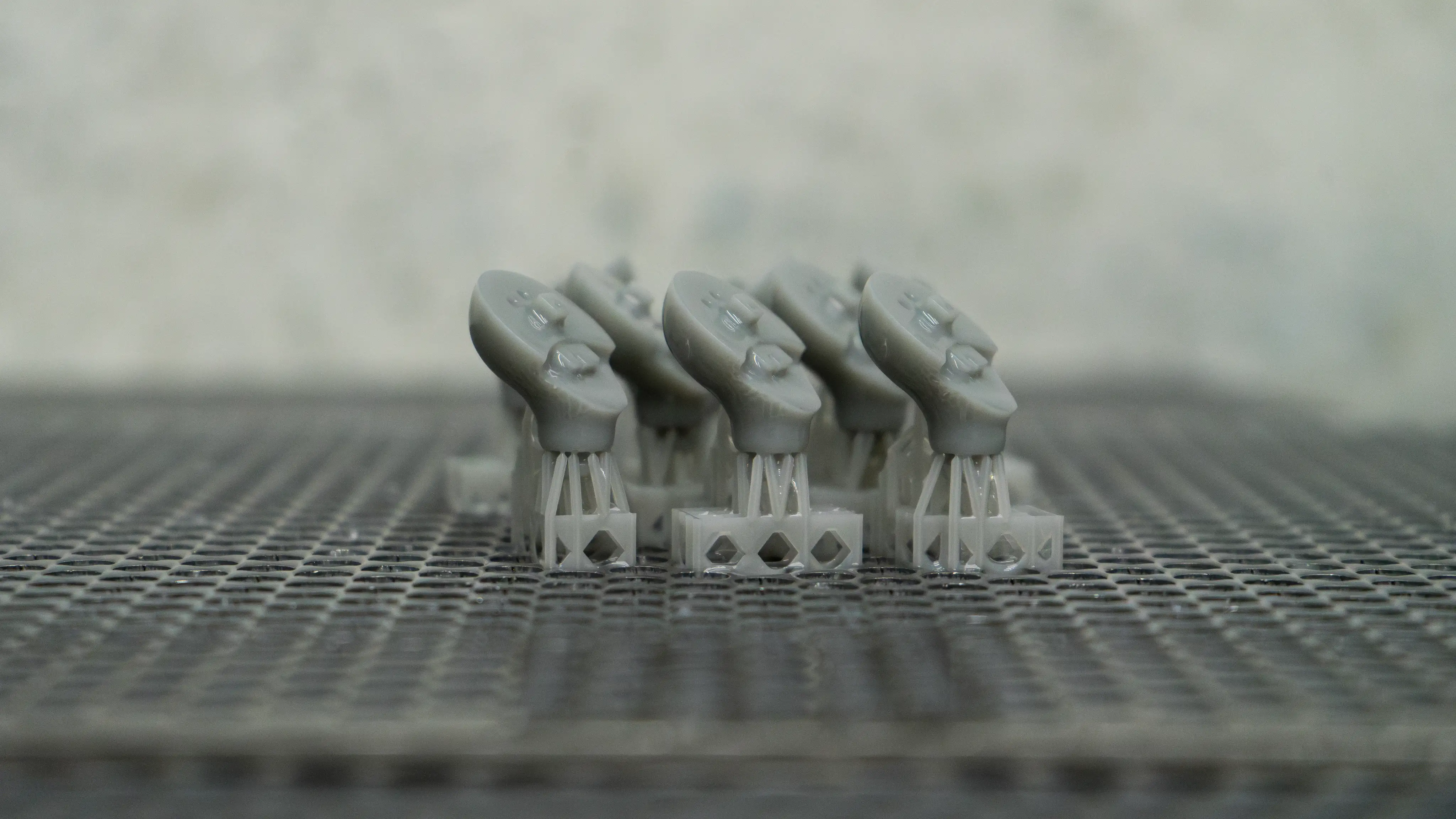
Accura Xtreme prints in a production-looking grey with a tensile strength of 38 to 44 MPa, 14 to 22% elongation at break and an HDT of 62 °C. It is tough enough for functional prototypes in demanding applications and for short production runs.
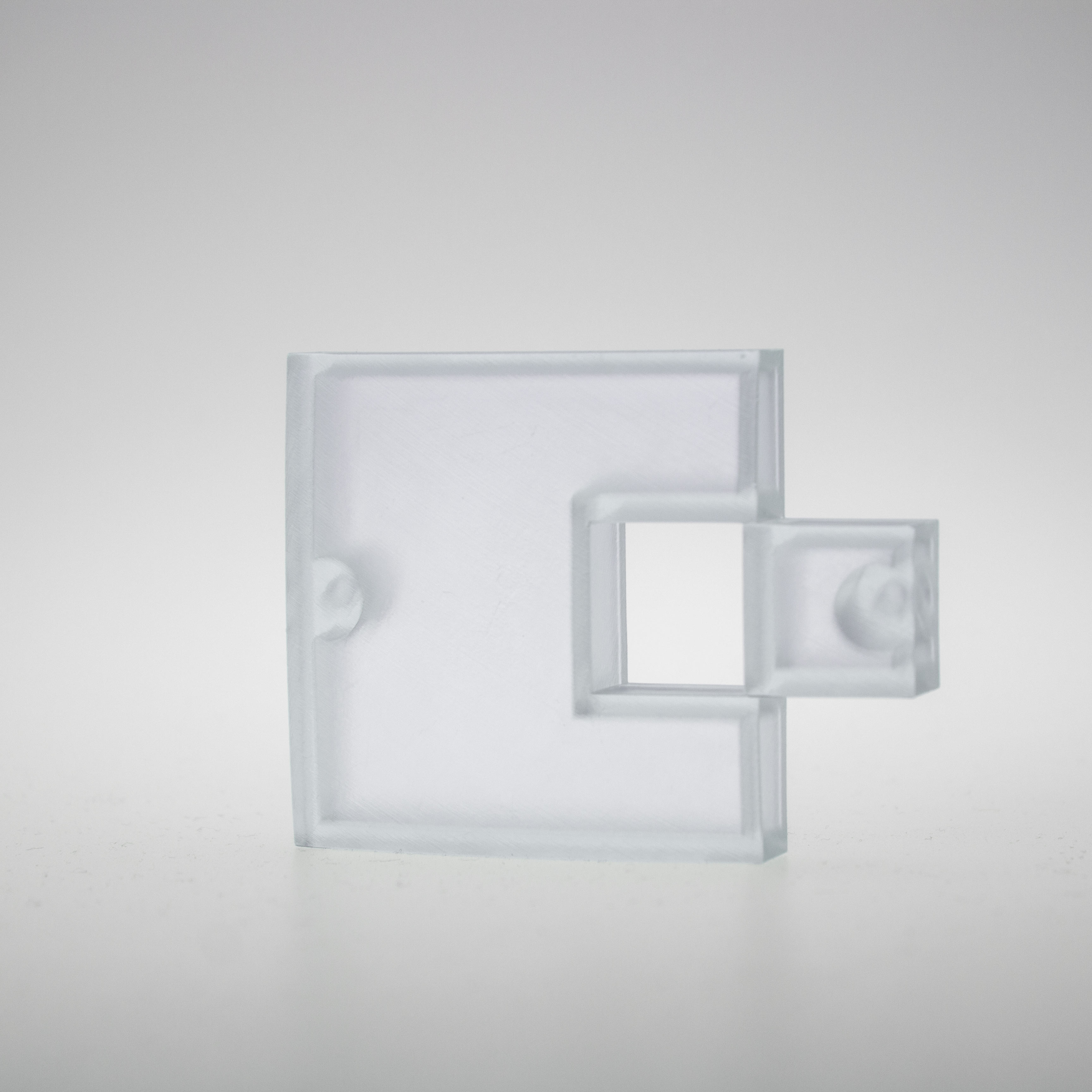
MPC12 is a multipurpose clear resin for functional prototypes and master patterns for silicone (RTV) moulds. It is also the resin for our largest single SLA parts, up to 450 × 450 × 450 mm. Tensile strength is 50 to 56 MPa and HDT is 49 °C.
Matte white SLA resin for snap fits, assemblies and master patterns
Rapid White (UK1618) prints in a matte white with a tensile strength of 40 to 44 MPa and 8 to 12% elongation at break. It resists breakage in snap fits and functional assemblies, and makes a good master pattern for vacuum casting.


WaterClear Ultra 10122 is a low-viscosity, optically clear SLA resin that produces accurate, functional parts with an acrylic-like appearance and little finishing needed. Use it for light pipes, fluidics, fluid flow analysis and see-through housings. Refractive index 1.52, tensile strength 56 MPa.
See every SLA material and data sheet we run, or read about 3D printing in Cambridge.
Need tens or hundreds of identical parts? See SLA batch production.
I-Dration water bottle: we grew the bottle in two parts on our in-house SLA machine, then used it to vacuum cast a clear, watertight body with LED lighting housed in the base.
Owlstone Ultra FAIMS instrument: we grew the master model on our SLA printer and finished it before vacuum casting the instrument casework, which grew from one- and two-off prototypes to runs of 10 to 30.
Blackfin Mobile push-to-talk handset (Wright Design): an investor model built on our high-resolution SLA machines. Our CAD engineers split it into components for clean colour breaks and added an internal cavity to bring it up to the correct weight, then we hand finished and painted the parts and CNC machined the acrylic screen.
Heart valve exhibition models: for a maker of replacement heart valves, we grew clear, sectioned hearts on our SLA machine to show each valve position, set inside three full-size CNC-machined acrylic figures.
Kitchen appliance display models: photography-ready models for the Argos catalogue, combining CNC-machined and SLA parts that we finished, assembled and branded in-house to a fixed deadline.
Sculptural creatures for an artist: a series of large sculptures 3D printed in two sizes, 80 cm and 40 cm, then finished, painted in many exactly matched Pantone colours and given a high-gloss lacquer in-house. We have made 6 to 8 of the larger and 10 to 15 of the smaller versions, in batches.
We also run these SLA resins in-house. Full properties are on each data sheet.
A flexible, polypropylene-class resin from 3D Systems for snap-fit assemblies, durable functional prototypes and parts that simulate white polypropylene. It also works as a master pattern for vacuum casting. Tensile strength 38 MPa, 13 to 20% elongation at break, HDT 58 to 63 °C.
Accura 25 data sheetAn ultra-tough white resin from 3D Systems, made to replace machined polypropylene and ABS parts. It handles snap fits and demanding assemblies, takes paint well and makes a good master pattern for vacuum casting. Tensile strength 45 to 50 MPa, 7 to 20% elongation at break, HDT 47 °C.
Accura Xtreme White 200 data sheetA rigid, light grey resin from R4PID UK for housings, enclosures, clips, brackets, fixtures and instrument components. Tensile strength 50 to 56 MPa, tensile modulus 3,000 to 3,300 MPa, HDT 56 to 61 °C.
Rapid Pro Grey data sheetThese are the figures our SLA department works to in Whittlesford, Cambridge. The design minimums come from Chris, our 3D Print Department Manager, and are the first things we check when your CAD arrives.
| Capability | What we work to |
|---|---|
| Tolerance | ±0.15 mm |
| Layer thickness | 0.05 mm as standard |
| Largest single part | 450 × 450 × 450 mm in MPC12 Clear; bigger parts are printed in sections and bonded |
| Turnaround | 24 hours standard, no rush fee; CAD by 5:30 pm usually delivered next day when capacity allows |
| Batch sizes | Typically 20 to 200 identical parts; largest batch 5,000 |
| Post-processing | IPA wash and UV post-cure; supports removed and bead blasted as standard |
| Finishing options | Painting and colour matching, polishing to water-clear, copper or nickel plating (up to about a 150 mm cube), bonded threaded inserts; painting or polishing adds at least a day |
| Feature | Minimum |
|---|---|
| Wall thickness | 0.4 mm supported; 0.8 mm unsupported |
| Holes | 0.4 mm diameter; holes print about 0.05 mm undersize, so ream critical holes |
| Clearance between mating parts | 0.1 to 0.2 mm |
| Text and logos | Embossed 0.4 mm; engraved 0.6 mm |
| Hollow parts | Two drain holes of at least 3 mm |
SLA parts hold ±0.15 mm, which makes them a good choice for fit testing, assemblies and master patterns.
SLA parts are turned around in 24 hours as standard, with no rush fees. CAD received by 5:30 pm is usually printed that night and delivered the next day, when capacity allows. Large parts need more planning, and painting or polishing adds at least a day.
Accura Xtreme Grey, Accura Xtreme White 200, Accura 25, Rapid White, Rapid Pro Grey, MPC12 Clear and Somos WaterClear Ultra 10122.
Yes. MPC12 and Somos WaterClear Ultra 10122 can be polished or clear-coated to a water-clear finish for light pipes, fluidics and see-through housings.
Yes. SLA is accurate enough for master patterns for vacuum casting, and many of our cast batches start as an SLA master that we finish in-house before the silicone mould is made.
Yes. We print anything from one part to thousands without tooling, and finish them in the same workshop. Most SLA batches are 20 to 200 identical parts, and our largest was 5,000.
SLA stands for stereolithography. A UV laser traces each layer of the part on the surface of a vat of liquid resin, curing it solid. The build platform then moves and the next layer is drawn. Finished parts are washed in IPA, the supports are removed and they are post-cured in a UV oven.
Strong enough for fit checks, snap fits and many functional tests: our SLA resins have tensile strengths of 38 to 56 MPa. They are stiffer and more brittle than moulded thermoplastics, so for impact, heat or outdoor use we recommend Carbon DLS, FDM in engineering filaments, or CNC machining.
Send us your CAD file with the material and quantity you need. SLA parts are turned around in 24 hours as standard, with no rush fees.